
From Anesthesiologist and Acupuncture Practitioner to Apitherapy Pioneer
What do acupuncture and apipuncture have in common? Needles and bee venom—and one name: Dr Stanko Buha (65), an anesthesiologist from Trebinje who, according to the article, is the only apitherapist in Europe to administer bee venom by injection! He arrived at this approach quite by chance, through an unusual combination of decades of experience in acupuncture, scientific curiosity and, ultimately, the persistence of his own patients.
Looking back at how he began practising this ancient yet insufficiently researched therapy, Dr Buha first recalls his long-standing passion for acupuncture, which he has practised for decades alongside his other medical work.
“I have been practising acupuncture for 35 years. As circumstances would have it, I gave lectures on acupuncture to various beekeepers’ associations in the region,” Buha says.
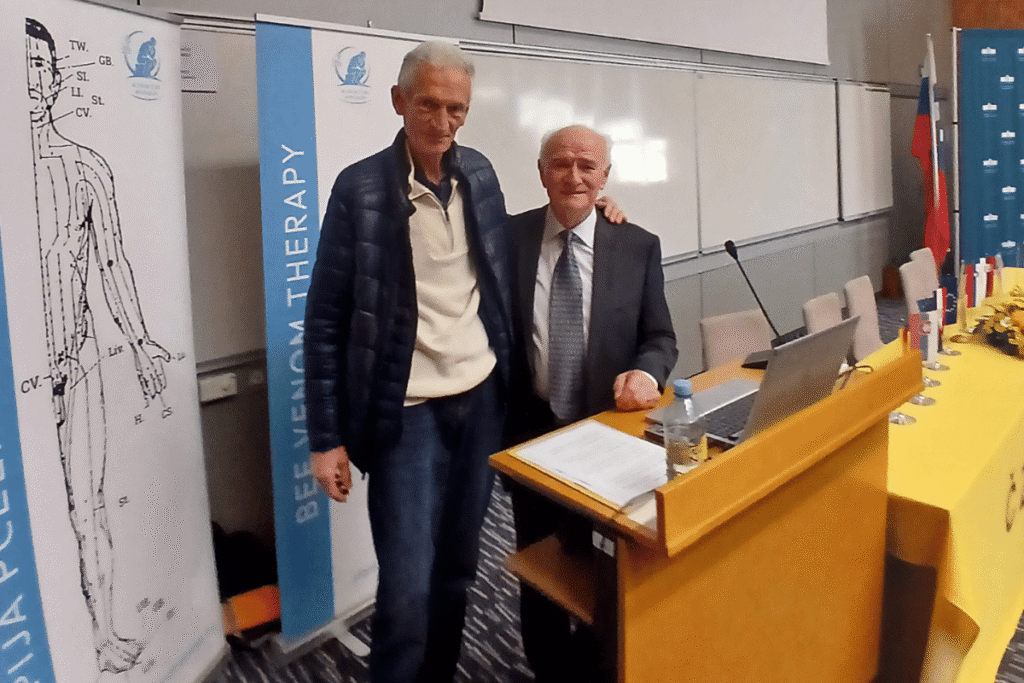
In an effort to popularize knowledge of acupuncture, he once gave a lecture to beekeepers in Trebinje.
“That was where I happened to meet Mića Mladenović from the Belgrade Apitherapy Association. He opened up entirely new horizons for me and pointed out the similarities between acupuncture and apitherapy. As I began exploring what acupuncture could offer beekeepers and delving deeper into the subject, he told me, ‘It’s the same thing. The points are the same; you just place a bee on those points,’” Dr Buha recalls.
Wanting to gain a thorough understanding of the subject, he began studying foreign literature, particularly Russian publications.
“Russians are world leaders in apitherapy. To connect acupuncture and apipuncture, I researched the effects of bee venom and was impressed by the results reported by Russian physicians in treating rheumatic and neuromuscular diseases. I was particularly fascinated by the work of Dr Igor Krivopalov Moskvin and the API Centre in Chelyabinsk, where remarkable results are reported in the treatment of neurological conditions such as multiple sclerosis. In his publications, Krivopalov Moskvin explains each point in detail, including how long it should be stimulated and how many points are used along the spine and at extraction sites,” Dr Buha explains.
Patients Took the Initiative
Although Dr Buha had acquired extensive theoretical knowledge, he had not initially planned to become an apitherapist. His original goal was educational.
“It wasn’t intentional; I hadn’t planned it, but books and patients practically pushed me in that direction,” Dr Buha explains.
His initial intention was to teach beekeepers and patients how to administer the therapy themselves, as his primary profession was anesthesiology. However, the opposite happened.
The turning point came in his medical practice.
“I talked about it with patients who came to me for acupuncture treatment. Two patients, one with multiple sclerosis and the other with Parkinson’s disease, obtained bee venom and asked me to administer the treatment. That is how we began in 2022. Today, we already have a considerable number of satisfied patients,” Dr Buha says.
A Unique Treatment Method in Europe
What sets Dr Buha apart from the vast majority of apitherapists worldwide is his exclusively medical approach, which avoids the use of live bees and their stings.
“Treatment can be administered through stings from live bees, as most apitherapists do. We administer treatment using bee venom injections. I am the only one in Europe who uses injections. The bee venom is dissolved in sterile saline solution and injected mainly subcutaneously into acupuncture points. For certain conditions, it is administered through an intravenous infusion or by lumbar injection into the spinal canal,” Dr Buha explains.
“I also receive a bee venom infusion once a month.”
As an experienced anesthesiologist, Dr Buha emphasizes patient safety during treatment.
“Before each treatment, an allergy test is performed. We wait half an hour and, if there is no significant reaction to the test, treatment begins. It lasts only about fifteen minutes and is performed under deep analgesia and sedation to prevent pain. I also receive a bee venom infusion once a month as a preventive measure. Of course, I undergo the test first,” Dr Buha explains.
He sources the bee venom from beekeepers.
“Bee venom consists of around 18 major components, and each of these components has a scientifically established role,” Dr Buha states.
From Pubic Bone Inflammation to Legal Absurdities
Although apitherapy primarily focuses on rheumatic and neuromuscular diseases, it has also reportedly shown promising results in treating sports injuries, for which conventional medicine may not always offer a definitive solution.
“When it comes to soft-tissue injuries, modern medicine officially says there is no cure. But I have seen how much bee venom can help with these injuries, according to my patients. It helps with conditions involving inflammation because it has anti-inflammatory properties,” Dr Buha explains.
Despite the results he reports, Dr Buha carries out his innovative work in something of a legal grey area.
“Under Serbian law, bee venom is classified as a poison and is regulated by laws governing toxic substances. Here in Republika Srpska, there is no such law, but there is also no legislation governing traditional medicine, either in Republika Srpska or throughout Bosnia and Herzegovina. As a result, I cannot register bee venom therapy under the legislation currently in force, but no one can prosecute me for it either, because there are no laws governing it,” Dr Buha states.
For 140 Years, No More Convincing Study Than Philipp Terc’s

As he explains, Philipp Terc, regarded as the father of apitherapy, reported in 1888 that 82% of his patients had recovered.
“And can you imagine that, for 140 years, there has been no more robust study, no research at all on this subject?” Dr Buha wonders.
Now, at the age of 65, he is actively searching for a colleague to join him.
“I am finding it difficult to find the right person. I am looking for a doctor, specifically an anesthesiologist, to work alongside me. I plan to open a hospital dedicated to apitherapy, but the first step is to introduce legislation that would allow such a facility to be registered and operate,” Dr Buha explains.